EL MONTE — Outside the El Monte Police Department, six names now tell a story that stretches across more than half a century. Some belong to officers whose sacrifices have been remembered in the city for decades. Others belong to men whose deaths remain painfully recent for their families, colleagues and the community.
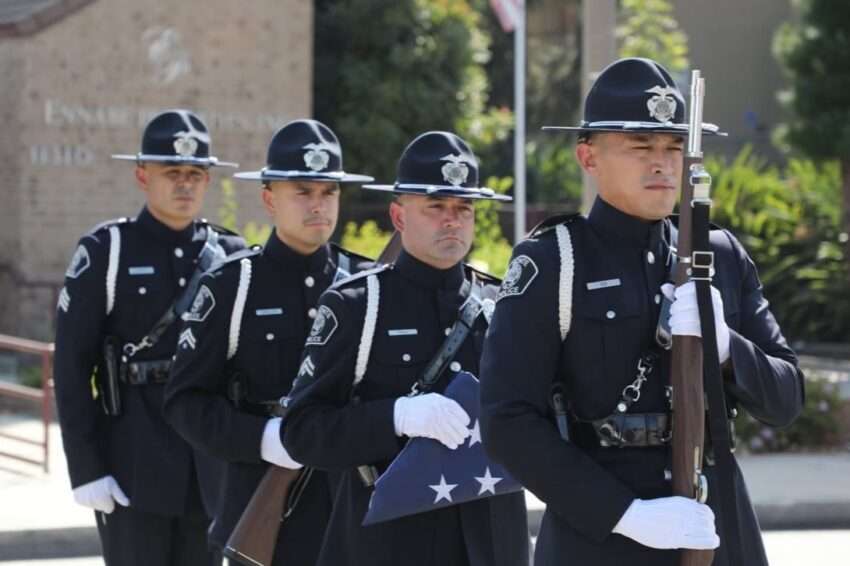
The El Monte Memorial Wall, unveiled Thursday, Aug. 6, outside the Chief Benjamin Lowry Police Services Building, brings those stories together in one place. It honors Officer Tony Arceo, Officer Terry Long, Detective Donald Johnston, Sgt. Michael Paredes, Officer Joseph Santana and Senior Detective Armando “Mando” Santa Anna.
Their circumstances were different, as were the generations in which they served. Yet each left a mark on the department and the community around it.
“Their courage, sacrifice, and unwavering commitment to protecting others will never be forgotten,” the city said in a statement marking the unveiling. “This Memorial Wall serves as a permanent reminder of their legacy and the profound impact they continue to have on our department and community.”
El Monte Memorial Wall Spans Generations
Perhaps no two names on the wall illustrate that history more closely than Arceo and Long, whose stories became intertwined on June 18, 1970.
Long was investigating armed men on Monterey Avenue when a bullet struck his spine, leaving him paralyzed from the waist down. As gunfire continued, Arceo crawled toward the wounded officer and pulled him to safety.
The shooting ended Long’s career as a police officer, but it did not end his professional life. He went on to attend law school and became an attorney, living for more than three decades before dying in 2004 from complications associated with his injuries.
Arceo would not have nearly as much time. Four years after saving Long, the 31-year-old officer responded while off duty to an armed robbery at a Baldwin Park pawnshop. He was killed in the July 9, 1974, gunbattle after six years with the department.
There was another painful detail to that day. Arceo had been scheduled that evening to receive a commendation from the El Monte City Council for rescuing an elderly blind couple from a burning home. Later that year, the city renamed El Monte City Park in his honor.
More than 50 years after Arceo pulled Long to safety, the two officers are remembered together again.
Service Continued Beyond The Injury
Detective Donald Johnston’s story carries a similar thread of sacrifice that extended far beyond the moment he was wounded.
On Jan. 29, 1990, Johnston confronted a man suspected of trying to cash a forged check at an El Monte bank. During the confrontation, he pushed a civilian out of the line of fire and was shot in the neck.
The wound left Johnston paralyzed, but it did not separate him from the department. Using a wheelchair, he continued serving as a background investigator and helicopter observer. He died Nov. 22, 2002, at age 48 from an illness attributed to the wounds suffered 12 years earlier.
The experiences of Long and Johnston give the memorial another layer of meaning. Their sacrifices unfolded over years, long after the emergencies that changed their lives had ended.
Information about the department and its community programs is available through the El Monte Police Department.
A Loss El Monte Still Remembers
The history represented on the wall eventually reaches events that many El Monte residents remember clearly.
On June 14, 2022, Paredes and Santana responded to the Siesta Inn on Garvey Avenue after a report of a possible stabbing involving a domestic dispute. Both officers were fatally shot after encountering the suspect.
Paredes, 42, had spent more than two decades with the El Monte Police Department and was posthumously promoted from corporal to sergeant. Santana, 31, had joined the department the previous year after serving with the San Bernardino County Sheriff’s Department.
Their deaths brought a visible wave of grief across El Monte. Flowers, photographs, flags and handwritten messages appeared outside the Police Department as residents gathered with officers and the families of the two men. Vigils and memorials followed, turning a law enforcement tragedy into a shared period of mourning for the city.
Four years later, the names of Paredes and Santana remain together, this time carved into a memorial meant to outlast the flowers and handwritten notes that once surrounded the station.
Remembering The Department’s Newest Loss
The newest name belongs to Santa Anna, whose death this year added another chapter to the department’s history of loss.
Santa Anna died March 15 at age 52 from complications following planned surgery related to a work injury. During approximately 24 years with the department, he served in assignments that included patrol, school resource officer and senior detective.
His death drew tributes from El Monte and law enforcement agencies across the region. Los Angeles County lowered flags to half-staff in his memory, while the El Monte City Council adopted a resolution supporting his family and authorizing the city to cover funeral-related expenses.
Less than five months later, his name joined five others outside the building where he had spent much of his career.
A Permanent Place For El Monte
What the El Monte Memorial Wall ultimately preserves is more than a record of deaths. It creates a place where different generations of the city can encounter the same history.
A longtime resident may remember Arceo’s name from Tony Arceo Memorial Park or recall the shooting that changed Long’s life. Others may remember Johnston continuing to work after losing his ability to walk. For many families, the deaths of Paredes and Santana in 2022 remain part of recent community memory, while Santa Anna’s loss is newer still.
For residents who know none of those stories, the wall offers a beginning.
Over time, memories of vigils fade, flowers disappear and people who knew the officers personally grow fewer. A permanent memorial gives their stories somewhere to remain.
That may be the wall’s greatest significance. Six men who served El Monte across different decades are now connected in one place, not simply by the circumstances of their deaths, but by the community they served.
Outside the Police Services Building, where another generation of officers continues to report for duty, their names will remain part of El Monte’s story.